When Ibrahim felt his world crashing down after completing university without job prospects, he did not have access to a psychiatrist but was enrolled in evidence-based trauma treatment was—delivered by locally trained counselors using culturally adapted methods that blend scientific rigor with community wisdom.
Today, Ibrahim not only manages his own mental health but has become a peer counselor, demonstrating that professional-quality mental health treatment is possible anywhere.
The global mental health crisis demands solutions that are both scientifically sound and locally relevant. In regions where psychiatrists don’t exist and cultural barriers to mental health treatment run deep, the challenge seems insurmountable. Yet breakthrough research and innovative implementation prove otherwise.
The Evidence Base: What Works in Low-Resource Settings
Recent meta-analyses involving over 258,000 people demonstrate that mental health interventions produce 0.084 standard deviation improvements in overall wellbeing, with larger effects when interventions move people across poverty thresholds.
Effective Interventions Include:
- Therapy adapted for cultural contexts
- Group therapy utilizing traditional cultural practices
- Community-based psychosocial support
- Task-sharing models training non-specialists
- Telemedicine-enabled supervision and consultation
Evidence from Our Programs:
- 98% improved emotional regulation among participants
- 65% reduction in severe depression rates
- 60% reduction in severe anxiety levels
- 83% reduction in depression (78% to 13%) in integrated programs
Cultural Adaptation: The Key to Effectiveness
Maryan Abdi’s Pregnancy Journey: This mother of three, seven months pregnant, struggled with mood swings and overwhelming stress. Initially, she “didn’t understand what was happening” and “thought medication was the only way to cope.”
Our culturally therapy helped Maryan understand that “mood swings are part of pregnancy and not something wrong with me.”
“I now know that it’s okay to seek help when I’m feeling stressed or anxious,” Maryan explains, demonstrating how cultural adaptation increases treatment acceptance and effectiveness.
Task-Sharing Innovation: Professional Standards Without Psychiatrists
The Training Revolution: Our evidence-based training transforms community members into competent mental health providers:
Clinical Counselors (2-Year Program):
- Hybrid E-Learning and In-Person training
- Supervised practice with real clients
- Cultural integration training
- Ongoing supervision through telemedicine networks
Community Counselors (3-Month Intensive):
- Problem-solving therapy techniques
- Crisis intervention skills
- Referral pathway training
- Cultural healing practice integration
Results Validation: Independent evaluation shows our trained counselors achieve outcomes comparable to formal mental health professionals in high-resource settings, while serving 100 clients monthly at $2.50-$4.15 per session.
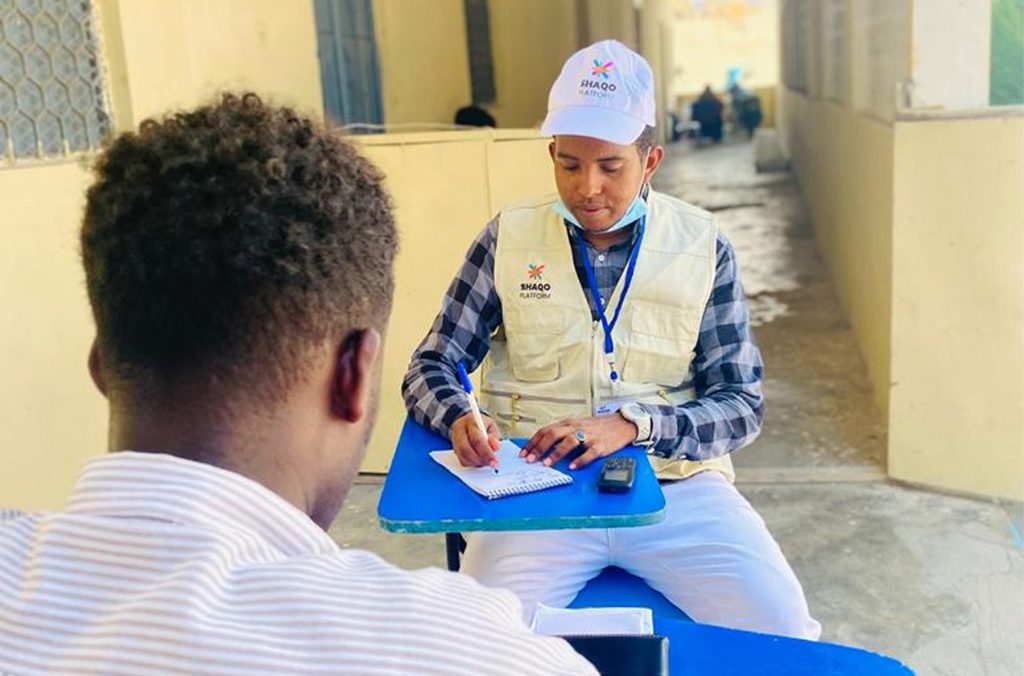
Technology-Enabled Quality Assurance
Telemedicine Networks: Our innovative supervision system connects community counselors with psychiatrists and clinical supervisors globally, ensuring:
- Real-time consultation for complex cases
- Ongoing professional development
- Quality monitoring and improvement
- Specialized intervention access
Ibrahim’s Transformation: Initially struggling to “open up to people when going through something,” Ibrahim’s perception changed through our training. “Mental health is basic for human life,” he now declares, using evidence-based techniques to support peers while pursuing his university studies.
Group Interventions: Leveraging Community Healing
Sadam’s Peer Support Model: After completing our group counselling program for trauma healing, 23-year-old Sadam provides daily counseling to his friend Abdi, whose parents died in civil war. Using structured problem-solving therapy techniques, Sadam helped Abdi:
- Process grief and trauma from parental loss
- Overcome educational failures and rebuild confidence
- Develop coping strategies for daily stress
- Start a successful small business
This peer-to-peer model, supervised by our professionals, extends therapeutic reach while maintaining quality.
Integrated Care Models: Mental Health Plus Development
Research Evidence: Studies consistently show that mental health interventions integrated with development programming achieve superior outcomes to standalone approaches.
Our Integrated Results:
- Employment programs with mental health support: 99.5% success rate
- Employment programs without mental health support: 88.3% success rate
- Economic value per person: 42% increase with mental health integration
- Return on investment: 4.37x vs 2.26x (94% improvement)
Crisis Intervention: Psychological First Aid at Scale
Khadija’s Emergency Response: When this 32-year-old mother experienced severe panic attacks and complete isolation, our trained team provided immediate psychological first aid:
- Breathing exercises and grounding techniques
- Emotional validation and normalization
- Safety planning and coping strategy development
- Referral to ongoing therapeutic support
Six months later, Khadija views “that night as a turning point,” demonstrating how evidence-based crisis intervention creates lasting transformation.
Measurement and Evaluation: Proving Impact
Systematic Assessment Tools:
- Standardized assessments adapted for local context
- Functional assessment measures tracking daily living improvements
- Economic outcome indicators measuring livelihood changes
- Community-level indicators assessing social cohesion
Longitudinal Results: Our follow-up studies show sustained improvements across all measures, with participants maintaining gains and often continuing improvement after program completion.
Innovation in Therapeutic Approaches
Amin Abshir’s Recovery Model: After suffering from depression, Amin accessed our integrated mental health and employment services. The combination of:
- Individual therapy addressing cognitive distortions
- Group support reducing isolation
- Skills training building confidence
- Peer mentorship providing ongoing support
Led to his healing, securing a scholarship, and internship, then helping a friend avoid dangerous migration by finding employment—demonstrating how healed individuals become community healers.
The Global Application
Our evidence-based model offers replicable frameworks for any low-resource setting:
- Assessment and Adaptation: Understanding local mental health needs, cultural practices, and existing resources
- Workforce Development: Training community members using proven curricula adapted for context
- Quality Assurance: Implementing supervision systems ensuring clinical standards
- Integration Planning: Embedding mental health into existing health, education, and development programs
- Sustainability Systems: Creating local ownership and revenue generation capacity
Research and Continuous Improvement
We are working to continuously improve our approaches based on rigorous evaluation.
For development partners seeking evidence-based solutions to the global mental health crisis, our model offers proven approaches with cultural relevance, professional quality with community accessibility, and immediate impact with long-term sustainability.